When a Face Replaces a File Number: Prosecutors Speak Out on How Personalized Justice Campaigns Reshape Their Priorities
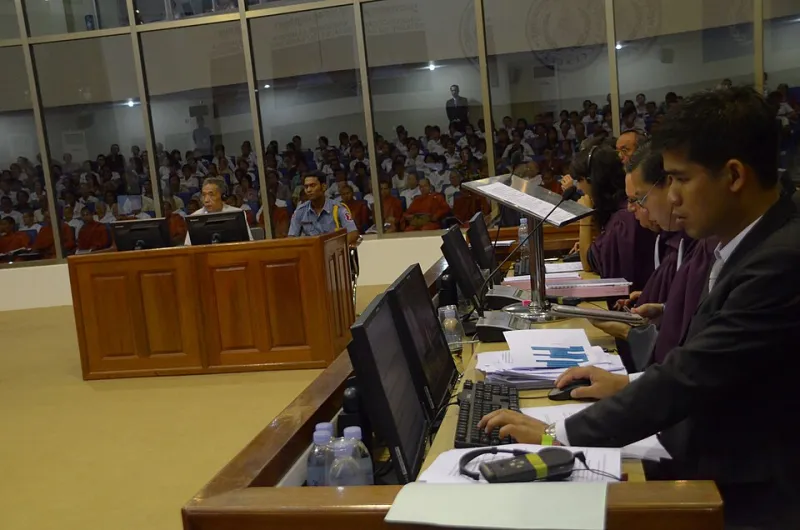
Photo: Khmer Rouge Tribunal (ECCC) from Cambodia, CC BY 2.0, via Wikimedia Commons
In the lexicon of a district attorney's office, cases are rarely referred to by the names of the people they represent. They are docket numbers, case files, and incident reports — language designed to impose order on overwhelming volume. But when a community rallies behind a name, when banners are raised and inboxes flood and city council chambers fill with grieving neighbors, something shifts inside those offices that no procedural manual has ever fully captured.
Justice for Jean spoke with more than a dozen current and former prosecutors, investigators, and law enforcement officials across seven states over the course of several months. What emerged from those conversations was a candid, sometimes uncomfortable portrait of how personalized justice campaigns — movements built around a single individual rather than a policy abstraction — alter the internal calculus of institutions that are, in theory, designed to treat every case equally.
The Confession Most Officials Won't Make on the Record
"I'll be honest with you in a way I probably shouldn't be," said one veteran assistant district attorney in the Mid-Atlantic region, who agreed to speak on condition of anonymity. "When there's community pressure attached to a name — a real name, a face, a family showing up — the political reality inside this office changes. That case gets reviewed. It gets resourced. Whether that's right or wrong is a different conversation, but it happens."
That admission, offered quietly and with evident discomfort, was echoed in some form by nearly every official we interviewed. A retired homicide detective from a Midwestern city put it more bluntly: "Statistics don't make my captain pick up the phone. A mother on the six o'clock news does."
The mechanism at work here is neither mysterious nor, in isolation, malicious. It is, rather, the predictable consequence of how human beings — including those employed by the state — process information and allocate attention. Psychologists have long documented what researchers call the "identifiable victim effect," the cognitive phenomenon by which a single, named individual elicits dramatically stronger emotional and behavioral responses than equivalent harm described in aggregate terms. A thousand cases lost to bureaucratic neglect register as a policy problem. Jean's case registers as a moral emergency.
How Campaigns Physically Alter Department Resources
The consequences of this dynamic are not merely psychological. They are logistical, budgetary, and institutional.
Several investigators we spoke with described specific, tangible ways that sustained public campaigns had redirected resources within their departments. Cold case units that had been operating with skeleton staffing received temporary personnel reassignments. Evidence that had sat unprocessed in backlogs was expedited. Supervisors who had previously declined to revisit closed or stalled investigations quietly authorized second reviews.
"There's a term we use internally — not officially, but informally — for cases that have community heat," said a former chief investigator from a Southern state. "'Community heat' means somebody's watching. And when somebody's watching, things get done that wouldn't otherwise get done. That's just the truth."
One prosecutor from a Northeastern state described a more formal version of this process: her office had developed an informal protocol, never written down, for flagging cases that had attracted organized public advocacy. Those cases were assigned to senior staff rather than junior prosecutors, and supervisors were notified of any procedural developments before they became public. "We called it 'elevated attention,'" she said. "It was our way of acknowledging that some cases carry external stakes that the standard workflow doesn't account for."
Justice or Triage? The Question That Haunts the System
The officials we interviewed were not uniformly comfortable with what they described. Several used the word "triage" — and used it with evident unease.
"Every case deserves the same attention," said a former public defender who now advocates for systemic reform. "But what we've built is a system so under-resourced that it can't deliver equal attention. So what fills the gap? Public pressure. Community organization. Media coverage. And those things are not distributed equally. They never have been."
This is the fault line that personalized justice campaigns expose without fully resolving. The Justice for Jean movement, like similar campaigns across the country, has demonstrated that organized, sustained, name-centered advocacy can compel institutions to act. But it has also illuminated, for anyone paying close attention, that the same institutions will remain inert in the absence of such pressure — leaving countless other Jeans without the community infrastructure to generate it.
A senior prosecutor in a Western state, one of the few officials willing to speak on the record, framed the dilemma with precision: "I believe in what advocates do. I've seen it work. I've seen families get answers they would never have gotten otherwise. But I also know that for every case that gets that kind of attention, there are fifty that don't. And those fifty families didn't love their person any less. They just didn't have the network, or the resources, or sometimes the racial or class privilege that makes certain cases more sympathetic to the public. That's a systemic failure, and campaigns don't fix it — they work around it."
What Advocates Can Do With This Knowledge
Understanding the institutional mechanics of "community heat" is not merely an academic exercise for those engaged in justice advocacy. It is operational intelligence.
If prosecutors and investigators respond to organized, visible, name-centered pressure, then the work of building that pressure — sustaining it beyond the initial surge of public attention, directing it at specific decision-makers with specific authority, and ensuring it reaches the desks of those with the power to act — becomes essential strategic work, not supplementary activism.
It also means that advocacy organizations like Justice for Jean carry a responsibility that extends beyond individual cases. Every campaign that succeeds in compelling institutional action generates a proof of concept that can be shared, replicated, and adapted by other communities fighting for other names. The infrastructure of accountability, once built, does not have to be dismantled between cases.
Several of the officials we interviewed said, unprompted, that they respected sustained advocacy campaigns precisely because they demonstrated organizational capacity. "When I see a movement that's still going six months later, that's still generating letters and showing up to hearings and following every procedural development — that tells me something," said one investigator. "It tells me these people are serious, they're organized, and they're not going away. And that changes my calculus."
The Reckoning the System Owes
The prosecutors and investigators who spoke with Justice for Jean were, almost without exception, individuals who entered public service with genuine commitment to the law's foundational promise: equal justice under equal scrutiny. Most of them acknowledged, with varying degrees of candor, that the system they work within does not consistently deliver on that promise — and that personalized advocacy campaigns have become, in effect, a pressure valve for a structure that would otherwise collapse under the weight of its own inequities.
That acknowledgment should not be read as an absolution of institutional failure. It should be read as a map.
The path to a system that does not require a community campaign to review a single case runs directly through the structural reforms that advocates have been demanding for years: adequate funding for investigative units, mandatory case review timelines, independent oversight of prosecutorial discretion, and accountability measures that do not depend on public attention to activate.
Until those reforms arrive, the work of campaigns like Justice for Jean remains not just meaningful but necessary. The name on the banner is not a workaround. It is a demand — a demand that every case, every file, every docket number, represents a person whose life and death deserve the full weight of the justice system's attention, whether the cameras are watching or not.