Bypassing the Blackout: How Local Journalists Become the Most Powerful Weapon in a Justice Campaign's Arsenal

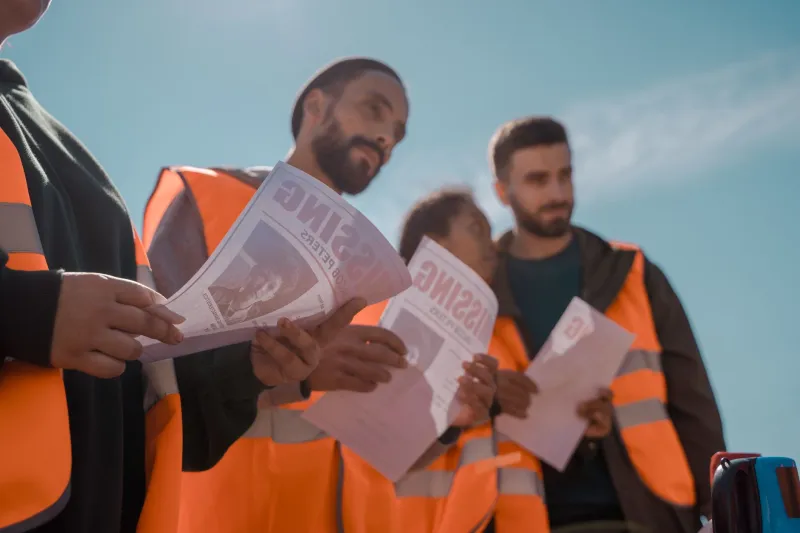
Photo: Marielle Velander, CC BY-SA 4.0, via Wikimedia Commons
Every advocate who has fought for a loved one's case knows the particular sting of a national newsroom's silence. Producers who don't return calls. Assignment editors who explain, with practiced sympathy, that the story "doesn't have broad enough appeal." Tip lines that swallow submissions without acknowledgment. For families seeking justice — for people fighting battles like the one that gave rise to this very platform — the indifference of major media outlets can feel like a second abandonment.
But the story does not end at the gates of a network studio. Across the United States, a resilient and often underestimated corps of independent reporters, community journalists, and regional investigative teams is doing work that national outlets routinely ignore. Understanding how to reach them, earn their trust, and sustain those relationships may be the single most consequential skill an advocate can develop.
Why National News Leaves So Many Cases Behind
To build effective media partnerships, it helps first to understand the structural logic that governs what national outlets choose to cover. The decisions are rarely personal, and they are almost never arbitrary. They are, instead, the product of economic pressures, audience metrics, and editorial frameworks that have calcified over decades.
Large outlets operate under what media scholars call a "newsworthiness hierarchy" — an informal but powerful ranking of which stories merit resources. Cases that rise to the top tend to share certain characteristics: a photogenic victim whose demographic profile resonates with the outlet's core audience, a narrative arc that can be resolved within a news cycle or two, and a geographic location that feels proximate to the outlet's primary market.
Cases that fall outside those parameters — disproportionately the cases of people of color, low-income families, rural communities, and anyone whose story resists a clean three-act structure — are quietly deprioritized. This is not a conspiracy. It is a market failure, and it has profound consequences for justice.
"I've watched cases sit completely dormant for years simply because no one with a byline was paying attention," says one veteran regional crime reporter who has covered overlooked cases in the Midwest for more than a decade. "The moment a local story gets published — even in a small paper — something shifts. Officials start returning calls. Prosecutors suddenly have availability. It's remarkable how quickly accountability follows ink."
The Distinct Advantage of the Regional Reporter
Local and regional journalists possess assets that their national counterparts often lack entirely. They have institutional memory about a community's political dynamics, longstanding relationships with local officials, and a readership that is directly affected by the outcomes they report. When a regional paper runs a story about a case, the people who can actually do something about it — the county sheriff, the district attorney, the state legislator — are often reading it over their morning coffee.
There is also a matter of access. A reporter from a community newspaper who has covered a county courthouse for fifteen years has a fundamentally different relationship with that building than a national correspondent parachuting in for a weekend. Sources trust them. Clerks know their names. That familiarity translates into stories that carry granular, verifiable detail — the kind of reporting that actually moves institutional needles.
Independent journalists, particularly those working in digital formats, bring a different but complementary set of strengths. Freed from the commercial constraints of legacy media, many independent reporters are willing to commit sustained attention to a single case over months or years. Platforms like Substack, independent news sites, and nonprofit newsrooms such as ProPublica's local affiliate network have become incubators for exactly this kind of long-form accountability journalism.
Building the Relationship: A Practical Framework
Advocates often make the mistake of approaching journalists the same way they approach social media — broadcasting broadly and hoping something lands. Effective media outreach requires a fundamentally different posture: patient, targeted, and relational.
Start with research, not a pitch. Before contacting any reporter, spend time with their archive. Understand what they cover, how they frame stories, and what kinds of sources they rely upon. A journalist who has spent two years investigating prosecutorial misconduct is a very different contact than one who primarily covers municipal budgets. Reaching out to the wrong reporter wastes everyone's time and can inadvertently close doors.
Lead with documentation, not emotion. Journalists need facts they can verify independently. When you make initial contact, come prepared with a clear, organized summary of the case — key dates, relevant public records, names of officials involved, and any prior coverage that exists. Emotional urgency is understandable, but a reporter's first question will always be: what can I independently confirm?
Respect the editorial process. One of the most common friction points between advocates and journalists is the advocate's desire to control the narrative. A legitimate reporter is not a publicist. They will speak to sources you'd rather they didn't, ask questions that feel uncomfortable, and sometimes reach conclusions that complicate your preferred framing. Accepting this is not a concession — it is the price of credibility. A story that appears to be one-sided advocacy will be dismissed; a story that demonstrates genuine journalistic rigor will be taken seriously.
Cultivate the relationship before you need it. The advocates who develop the most durable media partnerships are those who treat journalists as ongoing allies rather than on-call amplifiers. Share relevant public records even when you're not asking for coverage. Tip reporters to related stories that may not involve your case directly. Become a reliable source, and you will find that when your moment of urgent need arrives, the relationship is already in place.
When Coverage Creates Momentum
The practical effects of sustained local coverage on a justice campaign cannot be overstated. Prosecutors operate within political ecosystems. District attorneys are elected officials in most states, and elected officials respond to constituent attention. A single well-researched article in a regional newspaper can generate the kind of concentrated local pressure that years of petitions and social media posts fail to produce.
State legislators, similarly, are far more responsive to coverage in their home districts than to national headlines. When a reporter in a state senator's own backyard begins asking pointed questions about case backlogs or prosecutorial inaction, the political calculus changes rapidly.
This is the mechanism through which local journalism becomes a lever for systemic change. It is not merely about publicizing a single case — though that matters enormously. It is about creating a documented public record that officials must eventually respond to, and that future advocates can draw upon when building the case for legislative or institutional reform.
The Work Ahead
For anyone fighting a battle like the one at the heart of this platform, the road through local media is rarely swift or straightforward. It requires patience, discipline, and a willingness to engage with a process that does not always move at the pace that grief demands. But the evidence is clear: communities that invest in building genuine partnerships with regional and independent journalists consistently achieve outcomes that isolated advocacy cannot.
One voice, amplified through the right channels, can reach the ears of the people who hold the power to act. That is not a metaphor. It is a documented pattern, repeated in courtrooms and legislative chambers across this country. The blackout is real — but it is not permanent, and it is not absolute. Find the reporters who are already fighting to break it, and fight alongside them.